Back from the Silver Falls Retreat, Oregon

I’m back from the Silver Falls Retreat in Oregon, hosted by the SCBWI-Oregon chapter. I don’t believe there could be a more perfect setting for a writer’s retreat (other than Yosemite, perhaps); a rainforest-esque backdrop, splashes of autumn colors in the deciduous trees, patches of clouds dancing amongst the treetops, babbling brooks, delicate waterfalls and a group of highly creative children’s authors and editors.

Boy, was it hard to drive to PDX to catch my flight home!

Here are a couple of quotes from some of the speakers that you might enjoy:

“Anyone can write. Only a real writer can revise.”–Margaret Bechard

“I saw the angel in the marble and I just chiseled till I set him free.”—Deborah Brodie quoting Michelangelo.

“I recommend three things to all children’s writers: 1) take acting lessons (to better understand how to get into your characters), 2) voice lessons (for when you begin public speaking), and 3) join a storytelling group or class.”—Bruce Coville.

Writing in Rhyme: Part I

I love writing in rhyme. It’s a fun, challenging way to convey a story. And kids love it! There’s nothing like reading a well-written rhyming book to a young child. You can literally see the rhythm in their bodies!

I thought I’d write a bit about how to revise your rhyming work, but then it struck me that long before you get to the point of self-editing, you have to consider whether to rhyme or not.

A few years back, I took an online course from Anastasia Suen, on Poetry. One of the things she suggested that was that before you start writing your story in verse (rhyme), write it in prose. In other words, write the story first. Think about rhyme later.

Once you’ve written your story and determined if it’s a story worth telling, that’s when you have to take a hard look at whether you should rewrite it in verse. There is more to consider than just whether you like writing in rhyme. Consider the following:

* Is your story one that would benefit from a rhythmical pattern, such as a bedtime story like Goodnight Moon?
* Is there a natural pattern that emerges from the story’s events, such a cumulative story like The Napping House?
* Is there a natural cadence to your story that could be moved along with rhyme, such as Chicka-Chicka Boom-Boom?
* Can rhyming add another layer to your story in a natural, organic way (not feeling out of place or forced), like Sailor Moo, Cow at Sea?
* If you story has any type of pattern in it (seasons, alphabet, counting, music) then it could likely benefit from rhyme.

Then comes the hard part. Despite what the masses think, writing in rhyme is NOT easy. I’ll say it again because I cannot say it enough. WRITING IN RHYME IS NOT EASY. It’s far more than making your end lines rhyme. It takes hard work, tedious concentration and an ear for sound, plus lots of feedback. However, it can be done (just look at all the new rhyming stories on the children’s bookshelves).

In a few days, I’ll post more on how to self-edit your rhyming work.

2

More About Author Photos…

Here are a few more bits of wisdom I’ve come to notice in regards to author photos (you may recall my recent post on the subject)…

Snapshots: On rare occasions, snapshots have their place, but they really do belong more in the family album and not representing you as a professional writer. The problem with snapshots is that we love them because they capture a moment in time that’s special to us, but the rest of the viewers (editors, other professionals, potential book buyers) don’t get that. While a snapshot may make you feel all warm and fuzzy about that moment when you stood on the windswept cliff, all they see is your hair blowing every which way and you bundled up in so many layers that you look like a polar bear.

Amateur photos: These are better than snapshots, and when done well, can be just as effective as a professional photo. Try to use good lighting (outdoor/natural light works well), a natural look and pleasant background. Here are some things to be careful of: the busy writer hard at work at her desk, where the writer literally is lost amongst the clutter (I KNOW she’s in there somewhere!). Or, the writer/illustrator standing in the garden, but doesn’t realize that the background foliage makes it look like she has antlers or Martian antennae sticking out of her head. Remind your photographer to check the background as well as you, the subject. I recently had my husband take a picture of my in front of a blackberry bush, to promote my upcoming book, BLACKBERRY BANQUET (Sylvan Dell 2008). I made sure that the background was not dominating me. I wanted to be the standout, not the berry bush.

In addition to being aware of backgrounds that consume you, know that clothes and jewelry can do the same thing. The key—keep it simple! Simple clothing ad accessories won’t swallowed you alive. Whether you’re going for a casual look, a dressy look, or some sort of attire that ties into you book, make sure that it doesn’t overpower you.

One last comment: Don’t get me wrong about fun pictures that you can use to engage your audience and give them a sense of who you are (that’s where snapshots come in). Your readers, especially kids, LOVE to see a bit of your personal side.

Ahh, yes! A very fond memory for me, but would I REALLY want to use this as an author photo?

3

What’s This You Say?: A Glossary of Children’s Publishing Terms

The first SCBWI conference I attended made me realize that I had a thing or two to learn (okay, maybe more). In particular, I had to learn the lingo.

Imprint? Isn’t that what happens when you adopt a flock of ducklings and assume the role of their mother? SDT? Is that a social disease writers get when they don’t get to write often enough? And don’t even get me going on F & G’s!

I quickly learned that like any profession, field, sport, or community of people, there are certain words and terms that only those “in the know” understand. Here are a few terms that might help folks who are new to the kid-lit biz:

· Advance: Money paid to an author before the book is published. The amount of the advance must be earned back in royalties from book sales.
· Agent: Someone who acts on your behalf, selling your manuscript and negotiating your contract with the publisher.
· Antagonist: The villain of the story.
· Anthropomorphism: Giving human characteristics to animals.
· Acquisitions Editor: The editor who acquires or signs up manuscripts.
· Cover Letter: A letter sent with your manuscript to briefly explain your story and introduce yourself.
· Dummy: A manuscript that is laid out in book form, with one or two pieces of finished art.
· E-book: A book that is read only in an electronic format, instead of printed format.
· E-zine: A magazine that is read only in an electronic format, instead of printed format.
· F & G’s: Folded and gathered loose sheets. The unbound pages of a finished book.
· Fiction: Writing from the imagination (“made-up” writing).
· Format: The physical appearance of a book.
· Genre: The type of writing (i.e. board book, picture book, young adult…)
· House: As in “publishing house.”
· Imprint: A small, subdivision of a publishing house that usually publishes a distinct type of book(s).
· ISBN: International Standard Book Number. This gives each book a unique identification number.
· MS(S): Manuscript(s).
· Masthead: The place in a magazine where the staff is listed (usually near the front).
· Multiple/Simultaneous submission: When an author sends the same manuscript to more than one publisher at the same time. Some publishers DO NOT like this practice, therefore always check publisher’s guidelines.
· Non-fiction: Factual or informational writing.
· Personification: Creating characters out of non-living objects.
· Protagonist: The hero of the story.
· Query: A letter sent to a publisher to inquire if they would be interested in reviewing your work.
· Regional publisher: A publisher who specializes in books about certain areas of the country.
· Rejection letter: A letter from the publisher declining to accept your work.
· Royalty: Money paid to an author, based on a certain percentage of the price of the book times the number of books sold.
· SASE: Self-addressed stamped envelope.
· Self-publishing: When an author publishes his own book, assuming all production and marketing costs.
· Show-Don’t Tell (SDT): A common term used by editors meaning that you need to show what is happening in the story (rather than tell the reader what is happening).
· Slush pile: All of the manuscripts that a publisher receives that he did not request. It takes editors months to review the slush pile submissions.
· Unsolicited manuscript/submission: A manuscript that the publisher did not request from the author.
· Work-for-hire: When an author is paid a flat fee for their work, usually giving all rights to the publisher.

*Note: The book featured in the photo, “TheComplete Idiot’s Guide to Publishing Children’s Books” by Harold Underdown has an even more extensive list of terms.

SCBWI Conference Quotes and Bits of Wisdom

Here are a few quotes and summations I gleaned from the 2007 SCBWI Summer Conference.

Arthur Levine—When talking about receiving professional criticism, he reminded us that editors understand what authors feel when waiting for a reply because they go through a kind of “response anxiety” (my term, not his) when they send out revision letters. He’s always a bit eager to hear what an author thinks of his suggestions and how he/she will feel about them.

Walter Dean Meyers—“I give details on the internal landscape of a character.”

Lisa Wheeler—“Rhyme is the vehicle for telling a story… It shouldn’t become a bump in the road.”

Rubin Pfeffer—“A great book is one that sets a child off to read another book.”

John Green—“Great books do not happen by accident.”

Linda Sue Park—Revision is re-seeing the manuscript (macrochanges). Rewriting is re-writing (microchanges) by word choice, details, sentences, etc.

Roxyanne Young–The first step in revving up your PR machine is to define your audience. Who is your audience?

I also made more notes to add to my “conference tips” for next year, but that will come later–much later.
That’s it for now, folks.

2

Tips for Sailing Through the SCBWI Summer Conference

It’s almost that time again—the SCBWI Summer Conference is rapidly approaching. Yippee! An illustrator colleague of mine recently asked me about it, seeing how this will be her first time to attend. Since I’ve been a few times, I thought I’d offer up some tips–in no particular order of importance–just things as they randomly came to mind.

1. Take a sweater or jacket. While the hotel is lovely with the most comfortable hotel beds in the world (they don’t call them “Heavenly” for nothing), the meeting rooms and ballroom can be freezing! Of course, they can be stiflingly warm too. Take a cue from the Boy Scouts. Be prepared.

2. Predetermine your sessions. I like to determine my breakout sessions in advance, highlighting which ones pique my interest, but I also keep my ear out for other people who might have heard the same speakers in other sessions. That way, if I get a sense that the speaker doesn’t offer what I’m looking for I can change plans. I usually have a first and second choice highlighted on my conference flier. I’ve also found that it helps to read the books of the speakers you know you’ll be hearing.

3. Wear comfortable shoes. Even though we’re in the same hotel all day, there are three levels for conferencing, plus the treks to our rooms and dining opportunities. No one wants his or her piggies to be crying at the end of the day.

4. Food: IMHO, there are slim options for eating at the hotel: one nice restaurant—overpriced in my opinion, a poolside café, and the lounge/bar. For lunch, usually there’s a sandwich cart in the hotel lobby (sandwich, chips, soda/water), except on Sunday, due to the Golden Kite Luncheon. Oh, and speaking of the Golden Kite Luncheon (or as it’s affectionately called, “the parade of chicken breasts”), the dessert is always to die for! I’ve never been disappointedJ.

For dinners, my pals and I hoof it down the street to the mall (less than ten-minutes) where there is a variety of eateries at the food court. Saturday night we nosh at the poolside gala (a fun munch and mingle kind of thing—live music and a costume contest).
The only eating issue I’ve had is on Sunday night, but what I’ve found is that room service, while a bit spendy, offers large enough portions to share with my roommate. Plus, I usually take some snacks down with me (fruit, granola bars), so there’s enough to tide me over.

I honestly don’t know much about the breakfasts, other than the muffins, etc. that I’ve seen sold at the lounge/bar. I usually bring some homemade muffins so I don’t have to waste my morning time standing in a line. Coffeemakers are provided in the rooms, plus there’s free coffee in the lobby until around 11:00 or so.

5. Bring a book bag and money–especially you book addicts. Of course, there will be books sold and after hearing all of the fabulous authors, you’ll want to buy their books. Here’s a hot tip: the “cash” line is always shorter than the “credit card” line, so if you’re comfortable with it, bring some spare cash with you (hotel rooms do have safes for locking up your valuables).
Additionally, there are usually freebies (catalogs, posters, writing guidelines from various publishers, promotional materials from authors/illustrators). Now, I have to say that “freebies” doesn’t mean taking an author’s book from the display table. Eh-hem…yes, one year I took a copy of my new joke book to proudly display and by the end of the first day, someone had stolen it. Yep, stolen it! Can you believe that? I like to imagine a child somewhere is enjoying that book, and doesn’t know that how it came to land in his hands.

6. Take care of yourself. This is a personal one, because we’re all different, but I’ve learned to allow some “down time” for myself because four days of listening, learning, schmoozing and just plain hanging out with my writer and illustrator pals is fantastically exhausting. I bring a swimsuit for the Jacuzzi. Some folks participate in the yoga class. If you read my post on getting a good night’s sleep while traveling, you know that I bring a headset with quiet music. In essence, take care of yourself! It’s so very easy to overdo it.

7. Step out of your shell (if you have one). I know this is tough for a lot of people. The second conference I attended I didn’t know a single person. It was quite intimidating. I roomed with complete strangers who also didn’t know another soul in attendance. But I immediately discovered that children’s writers are some of the friendliest people on the planet. Some of those people I met way back then have come to be my closest writing friends.
One way to break the ice with people is to notice where they’re from (it’s on the nametags they give us) and strike up a conversation about that. If you’re waiting for a session to begin, chat with the person next to you. Ask them what kind of writing they do, if they’re published. Heck, you could even ask if they’ve read any good books lately! Remember, we all have a common bond of writing/illustrating for children, so there are a many interesting things to talk about.

8. Parking: If you carpool with a friend, drop the friend and all the luggage off at the hotel front then park the car. It’s a bit of a haul to lug all your bags from the hotel to the parking structure in the back.

9. Etiquette: Please don’t shove your manuscript under a restroom stall at an editor. It makes us all look bad. Manners, manners, manners! And I’m serious.

10. Expectations. Don’t expect to come home with a book contract in hand. That just doesn’t happen. What you will come home with is 1) newfound knowledge and skills, 2) new friends/colleagues, 3) editorial hope. By this, I mean that you will have heard editor’s speak and have the hope that because you better understand their needs, your work might find a place with them. However, this takes time—time for you to go home and re-evaluate your work (now that you have this newfound knowledge), time to further polish it (newfound skills), time to compose a well-thought out cover letter, and time for the editor to read it. That’s your hope 😉

BTW, I know that other conference vets will be addressing this same topic, so please check them all out to insure that you’ll have a great time. Gregory P. mentioned that he‘d be posting something, and Shrinking Violets Promotions has already posted Conference Survival Tips on their site (June 24, ’07).

Enjoy and happy conferencing!

CRITIQUE GROUPS

I love my critique group and feel very fortunate to belong in it. It’s composed of a group of writers from my SCBWI region, some published, some not-yet-published (but definitely will be). We’re an online group, because our region is vast and we live too far apart to meet in person on a regular basis. There are six of us, and each person brings something unique and special to the group, not only with her writing, but with her personality as well. I think what find most valuable though, from my critique group, is that they’re supportive in all the right ways. And I believe that any good critique group does the same.

A good critique group knows when to be honest with each other, to have the courage to say when something isn’t working in a story (isn’t that what having a pair of fresh eyes is all about?). Honest, thoughtful suggestions are what help to move one’s work forward. Blind, superficial praise does nothing to improve writing (although it might make the recipient feel good—but feeling good isn’t going to get your work published).

A good critique group also knows when to give each other a kick in the pants, on occasion. Members will look out for each other and not feel threatened by each other. Mutual respect is felt amongst the group along with a sense of helping each other toward their writing goals.

I have a friend who once belonged to a critique group and after every meeting, she would complain to me about them. She commented that they were either mean-spirited in their comments, or would blindly praise each other’s work—meaning, there was never any constructive criticism offered (“If I want to feel good about myself, I’ll let my husband read my work and tell me how brilliant I am.”) When she finally felt comfortable enough with the group to make suggestions for improvement on someone’s story, she was shut down. One person even told her that her suggestions were stupid.

My response? “That group is poisonous. Get out!” A critique group experience should leave you feeling hopeful, and anxious to dive into making improvements. You should feel a bit enlightened (“Hmm, I never thought of it that way!”). Your mind should be spinning with the excitement of digging into work, not like it’s been thrown into a ditch and there’s no way to climb out—whether you’re doing the critiquing or being critiqued.

So, what’s my point? Critiquer beware. Critique groups can be a valuable part of your writing experience, but enter with caution. Make sure that they’re helping you to improve your writing. And if not, politely “exit stage left” and move on. Maybe try a different group or maybe decide that critique groups aren’t right for you. The important thing is to find out what works for you.

Note: Check your local SCBWI chapter to see if they have a critique group coordinator to help you find a group in your area.

1

MY KIND OF REJECTION

Let’s face it—nobody likes receiving a rejection letter. Yes, there are things we can learn from them, but the bottom line is that a rejection is still a rejection. No sale. Nada. Zip. But once in a great while, a rejection letter makes me laugh—like the one I received today.

I sent the manuscript for The Blackberry Bush to a publisher (who shall remain anonymous) in August of 2005. Yes folks, that’s right. August of 2-0-0-5. Today, June 9, 2-0-0-7, I received a rejection letter on the story. Now, normally this would have really ticked me off (even though I’d have given up on said publisher long ago). But since The Blackberry Bush is now under production as Blackberry Banquet with the ever-insightful Sylvan Dell Publishing, I could laugh at this latest rejection letter.

So take heart–not all rejections will bring a howling cry of frustration. Sometimes they bring a howl of laughter–at the glacial speed of this business, or at the delight in knowing that someone else “discovered” your story while others missed that golden opportunity. It’s a crazy business we live in, isn’t it?

1

BLACKBERRY BANQUET: The Birth of a Cover

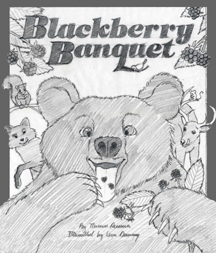
I was tickled purple when Donna German (at Sylvan Dell) sent me Lisa Downey’s rough illustration of the cover for Blackberry Banquet (see more of Lisa’s work here).

Here I go, like a new mom showing off her baby, but really…isn’t it adorable? I’m so pleased with the design and can envision the colors popping out and grabbing the attention of children. I can’t wait to see the finished piece!

I have a profound respect for picture book illustrators—they really are the ones who I put on a pedestal, in this business. Why? Because unlike fine artists (not to knock fine artists—I like Van Gogh just as much as the next girl), they have to bring the illustrations to life in order to create an entire story. They breathe life into the text. They don’t just paint a child or an animal; they show the movement, actions, and emotions of the characters. And they do it for thirty-two pages! Simply amazing, in my opinion.

Many people don’t realize that writers don’t get to choose their illustrators. Editors and/or art directors make that decision (good thing too—they know far more illustrators and have a tremendous understanding of what makes a good picture book). But this is a hard concept for some writers to get used to—letting go and trusting someone else to take “your baby” (especially if it’s your firstborn). Trusting that your editor will find an illustrator who will connect with your words, while also putting their own spin on them. Someone who will create pictures that will intertwine with your words to create a beautiful dance on the page. This is whom we want our editors to choose. And they do. But first, we must trust.

One of the things I’ve feared was seeing the artwork for one of my books for the first time, and not liking it. Well, it hasn’t happened yet. And every time I have to let go of one of my stories, I just tell myself, “Trust your editor. She will choose wisely.” It’s my mantra.

After all, she wants to create a beautiful book that will beg children to read it. And to keep it real, yes, sell books. Many, many books (it is a business, after all). And a book with the perfect balance of words and art will touch more children and sell many more copies than one that doesn’t. So, when the time comes to “let go,” take a deep breath and remind yourself, “Trust your editor. Trust your illustrator.”