
Those introverted ladies at Shrinking Violets Promotions sure know how to recognize a good title when they see one. I just found out that little old me won their most recent contest. Yippee! Oh, the joys of feeling validated! The contest was to use a book or song title and rewrite it from an introvert’s perspective. What was my entry? Ahh, you must click here to find out!
Yo-Ho-Ho: It’s Talk Like a Pirate Day!
 Shiver me timbers, today not only be me dad’s birthday, but tis also “Talk Like a Pirate Day!” Grab yer eye patch, put some swagger in yer step and swig down a bottle of …hmm, this is a children’s writing site…uh, apple juice.
To celebrate, here are some of my favorite pirate-related books and movies:
How I Became a Pirate by Melinda Long.
Peter Pan by by J. M. Barrie.
Pirateology by William Captain Lubber and Dugald A. Steer.
Pirate Mom by Deborah Underwood.
Movies:
Hook
Treasure Island
Pirates of the Caribbean: Curse of the Black Pearl (the only one of the trilogy that’s worth a pirate’s weight in gold, but ah, it be a grand one at that!)
And for all ye scalliwags who need a refresher course in Pirate-speak, here be some glossaries that only be a rope’s throw away: Pirate Glossary and the Brethren of the Coast.
Now git to yer talkin’ or walk the plank!
Wicked
Last weekend my husband and I went to the Pantages Theatre to see WICKED. What a treat! I hadn’t read the novel, Wicked: The Life and Times of the Wicked Witch of the West by Gregory Maguire, so all I knew was that it was the backstory to The Wizard of Oz. And what a great story it was, not to mention the acting, singing, coreography and sets. I was reminded of the flood of fractured fairy tales in the children’s book market not too long ago. This was like one of those stories tenfold. If you get a chance to see it, don’t pass it up. It’s worth every penny.
What’s This You Say?: A Glossary of Children’s Publishing Terms

The first SCBWI conference I attended made me realize that I had a thing or two to learn (okay, maybe more). In particular, I had to learn the lingo.
Imprint? Isn’t that what happens when you adopt a flock of ducklings and assume the role of their mother? SDT? Is that a social disease writers get when they don’t get to write often enough? And don’t even get me going on F & G’s!
I quickly learned that like any profession, field, sport, or community of people, there are certain words and terms that only those “in the know” understand. Here are a few terms that might help folks who are new to the kid-lit biz:
· Advance: Money paid to an author before the book is published. The amount of the advance must be earned back in royalties from book sales.
· Agent: Someone who acts on your behalf, selling your manuscript and negotiating your contract with the publisher.
· Antagonist: The villain of the story.
· Anthropomorphism: Giving human characteristics to animals.
· Acquisitions Editor: The editor who acquires or signs up manuscripts.
· Cover Letter: A letter sent with your manuscript to briefly explain your story and introduce yourself.
· Dummy: A manuscript that is laid out in book form, with one or two pieces of finished art.
· E-book: A book that is read only in an electronic format, instead of printed format.
· E-zine: A magazine that is read only in an electronic format, instead of printed format.
· F & G’s: Folded and gathered loose sheets. The unbound pages of a finished book.
· Fiction: Writing from the imagination (“made-up” writing).
· Format: The physical appearance of a book.
· Genre: The type of writing (i.e. board book, picture book, young adult…)
· House: As in “publishing house.”
· Imprint: A small, subdivision of a publishing house that usually publishes a distinct type of book(s).
· ISBN: International Standard Book Number. This gives each book a unique identification number.
· MS(S): Manuscript(s).
· Masthead: The place in a magazine where the staff is listed (usually near the front).
· Multiple/Simultaneous submission: When an author sends the same manuscript to more than one publisher at the same time. Some publishers DO NOT like this practice, therefore always check publisher’s guidelines.
· Non-fiction: Factual or informational writing.
· Personification: Creating characters out of non-living objects.
· Protagonist: The hero of the story.
· Query: A letter sent to a publisher to inquire if they would be interested in reviewing your work.
· Regional publisher: A publisher who specializes in books about certain areas of the country.
· Rejection letter: A letter from the publisher declining to accept your work.
· Royalty: Money paid to an author, based on a certain percentage of the price of the book times the number of books sold.
· SASE: Self-addressed stamped envelope.
· Self-publishing: When an author publishes his own book, assuming all production and marketing costs.
· Show-Don’t Tell (SDT): A common term used by editors meaning that you need to show what is happening in the story (rather than tell the reader what is happening).
· Slush pile: All of the manuscripts that a publisher receives that he did not request. It takes editors months to review the slush pile submissions.
· Unsolicited manuscript/submission: A manuscript that the publisher did not request from the author.
· Work-for-hire: When an author is paid a flat fee for their work, usually giving all rights to the publisher.
*Note: The book featured in the photo, “TheComplete Idiot’s Guide to Publishing Children’s Books” by Harold Underdown has an even more extensive list of terms.
TWTF: Tigger Was The First
Early Sunday morning thought. My cat woke me at 5:00 to remind me to get up and work on my novel—and give him his morning treats—which I did, like any obedient cat slave–I mean, owner. Now, light has filtered in to my office and my left-brain is too awake to novel-write anymore, which led me to think on other things.
Yesterday I attended a “critiquenic” in Bakersfield, CA, with a group of fellow SCBWI members. We got to talking about teen-lingo and activities, such as text messaging. Someone brought up the fact that there is a book series by Lauren Myracle, called The Internet Girls. The book titles are “TTYL,” “TTFN,” and “L8R G8R” (I’ll let you figure them out ;-).
On my drive home, I was thinking about this, and it occurred to me that the text-messaging thing isn’t all that new. Well yes, the means to do it is, but abbreviating words to convey messages was started long ago. By Tigger, of all people (yes, I look at Tigger as a person).
Our beloved Tigger, who was created by A.A. Milne, as one of Winnie the Pooh’s friends, and later took on an even grander life with the help of the early Disney geniuses, was ahead of his time. It was Tigger who bounced away, hollering back to his friends of The Hundred Acre Woods, “TTFN!”
What a cat! Let’s here it for Tigger, a feline well ahead of his time.
TTFN…
PEAK: A Pinnacle of Reading
 I love a good adventure novel, and when I’d heard about PEAK, by Roland Smith, I had to read it. The story is about 14-year old Peak Marcello, the son of two divorced mountain climbers. When Peak is caught scaling (and tagging) a NYC skyscraper, he finds himself facing the NYC courts.
In an effort to avoid having her son serve time in juvenile detention, Peak’s mother agrees to let his absent father of seven years (and world famous mountaineer) take Peak to Thailand, where he owns a climbing company. Ah, but the plot thickens when we discover that his father has an ulterior motive. This is the catalyst that launches Peak into every serious mountain climber’s dream—to summit Mt. Everest.
I was most impressed in the story’s details. Smith obviously researched this book at great depths, and I wouldn’t doubt that he’s climbed a mountain or two himself (he does reside in Oregon, after all). His descriptions of high altitude climbing were thorough and informative, without feeling forced.
Like any good climb, the plot takes some interesting and unexpected twists and turns, particularly the ending (which I won’t give away here—you’ll have to read the book yourself to find out that little gem). The story has all the things that make for a great adventure: an awesome setting, human drama, tension, friendship, sacrifices, unexpected twists, heroes, a villain and a satisfying ending. I will say though, that while I loved this ending for a teen novel, I would find it unbelievable had this been this written for the adult market. Good thing that didn’t happen!
PEAK by Roland Smith
ISBN 978-0-15-202417-8
One Writer’s Advice: Save Those Good Photos
 I love so many things about being an author, but one thing that I loathe is the photo thing. A simple reality that you cannot escape is that once you have a book out, someone (most likely your publisher) is going to want a photo of you for publicity purposes.
I hate this.
You might say, “Why Terry, you’re always such an upbeat person, why the sudden negativity?” Or as my husband would say, “Honey, would you like a little cheese to go with that whine?”
Well, I’m in the process of organizing a PowerPoint presentation for the annual SCBWI Ventura/Santa Barbara Writer’s Day (click here for details), and I have to include two photos of myself. Ugh…two??? Whose big idea was this anyway? Oh, right…that would be Alexis, my regional advisor (thanks, Alexis!). But I really only have myself to blame, as I’m the coordinator so I should have come up with some clever excuse to exclude myself.
I’ve been sorting through pictures and it’s no easy task—hmm…do I want something that shows what I do in my spare time (maybe catch the attention of that editor who has been looking for someone who knows a lot about backpacking or trimming cats’ claws), or do I choose one of me doing a school visit (to appeal to that person in the audience who is in charge of booking authors at his/her school), or do I pick one that shows me surrounded by my cats as I’m scribbling away on a notepad (to connect with the other writers in the audience). Now before you say, “Holy cow, Batman, that’s the longest run-on sentence I’ve ever seen!” or “You husband is right—you DO need a little cheese to go with that whine!” you must understand my frustration.
I collect photos from many other authors and illustrators for this project, and some (ahem, Mary Hershey, Val Hobbs, Lee Wardlaw, to name a few) take awesome photos! (Wait—it just occurred to me that they all live in Santa Barbara. Maybe they all use the same photographer–yes, surely that’s it.). Compared to some of these other writers, I feel like I should put a bag over my head with a couple of holes for eyes. Hmm…I do have some artistic friends who could come up with a really pretty bag…
I used to think it was because I didn’t have enough selection (I was always the person shooting the pictures), but I’m finally remembering during the course of the year to take pictures of me at interesting moments. Uh…that didn’t seem to help either. Let’s face it, but there’s nothing like a picture taken by a professional photographer. And I didn’t see any this summer on Mt. St. Helen’s or on that cool whale watch I did off of Cape Cod.
So once again, I’ll harangue my poor husband into taking about 30 pictures of me so that I can find one that doesn’t make me totally cringe (until I can find a reasonable photographer that I like where I live). It’s like the old I Love Lucy episode where she and Ethel have to get pictures for their passports for Europe. They have to settle on the best one out of 100, and even at that, poor Lucy’s face is as twisted as a pretzel.
What’s my point? Save those good photos (unlike the one above)—save the posed shots, action shots, professional ones and fun snapshots. You never know when you’ll need a huge selection to find “the magic one” for the right publicity opportunity. That is, unless your Mary, Val or Lee!
The Healthy Writer: It’s a Bird, It’s a Plane, No—it’s a TheraCane!

I hate knots. Not as in a figure-eight loop, a fisherman’s or a square knot. I’m talking about the ones that get in my upper back and shoulders after hours of writing at the computer. But thanks to a helpful little tool I’ve discovered, I can combat those “naughty” little knots.
Meet the “TheraCane.” It looks kind of like a torture device used by Santa Claus, but it’s anything but that. You position the TheraCane to massage out knots, or “trigger points” that accumulate in your muscles from extended use (basically caused from an accumulation of lactic acid—at least that’s what my doctor tells me).
There are many ways to hold the cane to allow you to get to various parts of your back and neck, but the one shown here is the one I use the most. Another favorite way I use it is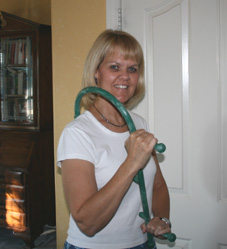 to hold the small nubby part against the notch at the base of my skull and gently massage. This helps with headache pain caused from neck strain.
To learn more about the TheraCane, click here, or Google it to find a selection of prices.
Note: This is a sharing of information from one writer to another (well, maybe quite a few others) about something that I’ve found to help me. I’m not a medical professional. Consult with your own doctor first.
SCBWI Conference: A Night with the Queen
 Pictured (left to right): Terry Pierce, Cecilia Noyes, Greg Trine, Tina Nichols Coury, Rebecca Langston-George, Yuki Yoshino, Alexis O’Neill
I had to post this picture, just for the fun of it. Every year, at the SCBWI Conference in Los Angeles, on Saturday night there is an poolside gala. Part of the festivities includes a costume contest. This year’s theme was, “By the light of the silvery moon.”
I was so happy when my writer friend, Tina Nichols Coury, won this year, dressed as the Silvery Moon Queen, along with her royal court, Greg Trine and Yuki Yoshino (also terrific writers and friends). If you go to Tina’s blog, Tales from the Rushmore Kid, you can scroll down to see some of the details on how she created her amazing costume. Way to go, Tina!
Dessert Challenge @ GottaBook
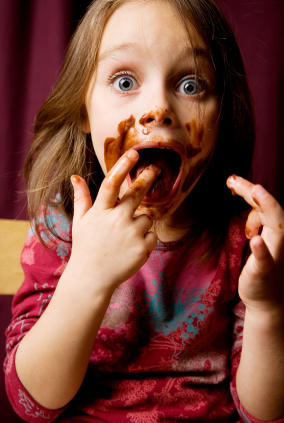
My blog friend, Greg Pincus, has taken my comment that if he doesn’t have a favorite dessert it’s because he hasn’t tasted them all, to a challenge. He’s going to make it his life’s mission to find the perfect dessert and is welcoming others to joing him (a noble quest, don’t you think?)I told Greg that of course, I’m willing, even though I already have a couple of favorites (yes, I’m just that good of a friend).
The best dessert I ever had was at the 1999 SCBWI Golden Kite Awards luncheon at the Century Plaza Hotel in Los Angeles. It was a work of art—a paper-thin crispy waffle-style cup, lined with dark OMG chocolate (that’s the good kind—the stuff that makes you say, “Oh My Gosh!”). Inside was thick French vanilla bean custard, drizzled with more dark chocolate. Over that, was a scattering of raspberries and blueberries, drizzled with more chocolate, and topped with whipped cream and more berries. Even the plates were artfully decorated with raspberry sauce drizzled into beautiful patterns. I think the hotel pastry chefs deserved a Golden Kite Award for their artistic achievement!
I long for that dessert…but alas, I fear I shall never have it again (my thighs are thanking me).
So here’s a challenge—how would you describe your favorite dessert? We’re all wordsmiths here—give it your best shot. Make my mouth water with your scrumptious word choices. I dare you!
 Terry Pierce

You must be logged in to post a comment.